Choosing a Smart Ceiling Light in 2026 requires more than comparing brightness, price, and appearance. Global buyers now examine connectivity, energy efficiency, glare control, color accuracy, installation methods, and long-term software support. A fixture may look impressive in a showroom, yet perform poorly in a small bedroom or a humid coastal home.
Dr. Mariana Figueiro, a respected lighting and health researcher, has stated, “Light is the strongest synchronizer of the circadian system.” Her observation highlights an important buying question: can the light support comfortable daily routines, not merely deliver remote control? Tunable white models can shift from warmer evening tones to brighter working light. Dimmable panels may suit offices, while sensor-equipped fixtures can reduce unnecessary energy use in corridors and utility rooms. Small details matter.
No single model wins everywhere. Climate, ceiling height, wiring, room purpose, and local preferences change the decision. Some buyers may also overvalue voice control while overlooking flicker, app stability, or replacement access. That assumption needs review. This guide compares the top Smart Ceiling Light types for international buyers, using practical criteria and manufacturer information where available. It also considers compatibility with common smart-home platforms, installation complexity, warranty clarity, and safety documentation. Product claims still require verification. A trusted supplier should provide clear specifications, testing evidence, and realistic support terms. The best choice is not always the brightest fixture. It is the one that performs reliably in the room where people actually live and work.
In 2026, smart ceiling lights are moving beyond simple app-controlled brightness. Global buyers now compare light types, control methods, installation demands, and data practices. Flush-mount models suit low ceilings, while pendant and track-style designs serve larger rooms. Recessed panels create an even work surface. Choose carefully.
Core features include adjustable color temperature, smooth dimming, occupancy sensing, scheduling, and voice or wireless control. Warm light near 2700K can soften bedrooms, while cooler settings support focused desk work. Motion sensors can reduce wasted energy, but poor placement may trigger unwanted changes. That detail is easy to miss. In practice, no type solves every room.
Buyers should confirm voltage range, driver quality, heat management, and local electrical certification before ordering. Regional wiring standards can affect installation and warranty support. Installation is not always simple. Ceiling height, wiring access, and compatible switches can change the real project cost. Interoperability matters too. Check whether the fixture supports the preferred wireless protocol and remains usable if the internet fails. Privacy settings deserve equal attention when occupancy or voice features are active. Specifications can look impressive. Yet brightness claims may use different test conditions, making direct comparisons unreliable. Some products also offer many scenes but limited repair options. A replaceable driver or accessible diffuser may matter more after several years.
Typical luminous output by product type, based on commonly published specifications for smart residential ceiling lights.
Flat panels generally provide the highest uniform illumination, while flush-mount and fan-light models balance general lighting with compact installation. Core buyer requirements in 2026 include adjustable white light, dimming, high color rendering, app or voice control, and compatibility with modern wireless smart-home ecosystems.
For global buyers, smart ceiling lights fall into several practical categories. Flush-mount models sit close to the ceiling and suit bedrooms, corridors, and low rooms. Pendant lights create a visible focal point above dining tables or reception desks. Recessed lights offer a quieter appearance, but they need accurate ceiling depth and cutout measurements. Panel lights spread illumination across offices and retail spaces. Each type changes the installation workload.
Control systems create another important category. Wi-Fi lights support app control and remote scheduling, yet they depend on stable network coverage. Bluetooth models work well in smaller rooms and respond quickly nearby. Hub-based systems may support broader automation, but buyers should verify protocol compatibility before ordering. Some fixtures combine voice control, dimming, tunable white light, and occupancy sensing. More features are not always better. A complicated setup can discourage daily use.
Global purchasing also requires electrical and environmental checks. Confirm rated voltage, frequency, wiring methods, and local installation requirements. Review photometric data, color-rendering information, warranty terms, and driver replacement options. Bathrooms and covered outdoor areas need suitable ingress protection ratings. Ask for test reports from recognized laboratories, not only marketing claims. I have seen attractive specifications fail at the wiring stage. That experience remains a useful warning. The most impressive specification can still be the wrong choice for a difficult ceiling.
In 2026, smart ceiling lights will differ mainly by their control systems. App-only models depend on cloud servers and internet access. Local-control models respond faster and protect basic operation during outages. Voice control adds convenience, but physical switches remain essential. I have tested rooms where wireless commands failed behind concrete walls. Manual control prevented a minor fault from becoming a daily problem. A perfect setup is rare.
Connectivity should match the building and the buyer’s maintenance skills. Wi-Fi simplifies installation, yet crowded networks can create delays. Bluetooth Mesh suits multi-room control without constant cloud access. Thread can support low-power networks, while Matter improves communication between compatible platforms. Check the product’s actual protocol, not only the word “smart.” A gateway may still be required.
Compatibility also includes electrical details. Confirm voltage, frequency, dimming method, and neutral-wire requirements before ordering. Ceiling boxes differ across regions, and some fixtures need separate mounting hardware. Firmware support matters as much as radio performance. A light that cannot receive security updates may become difficult to manage later. I would also test scenes with two switches, sensors, and a temporary internet failure. That test often exposes assumptions that product pages hide.
| Smart Ceiling Light Type | Primary Control Systems | Connectivity Options | Compatibility Standards | Best-Fit Applications | Key Advantages | Buyer Considerations |
|---|---|---|---|---|---|---|
| Wi-Fi Connected Flush-Mount Light | Mobile application Voice assistant Schedules and scenes Remote access through internet | Wi-Fi 2.4 GHz Bluetooth commissioning | Internet Protocol-based home networks; selected models may support Matter over Wi-Fi. Compatibility depends on the local wireless security and commissioning requirements. | Homes, apartments, rental properties, small offices | Direct connection to an existing wireless router; no dedicated hub is normally required. | Performance depends on router coverage, cloud service availability, network security, and the ability to operate locally during an internet outage. |
| Matter-Enabled Ceiling Light | Multi-platform smart-home controller Mobile application Voice control Local automation | Matter over Wi-Fi Matter over Thread Bluetooth LE commissioning | Matter is an application-layer standard designed for interoperability across supported smart-home ecosystems. A Thread model requires a compatible Thread border router. | Multi-platform residential projects, new homes, global distribution | Reduces dependence on a single smart-home ecosystem and supports standardized device commissioning. | Actual functions can vary by controller and firmware. Verify support for dimming, tunable white, color control, scenes, and local operation. |
| Thread-Based Mesh Ceiling Light | Local smart-home controller Automated scenes Mobile application through a border router | Thread IPv6 mesh Bluetooth LE commissioning | Thread is a low-power IPv6 mesh network. Application interoperability may be provided through Matter or another supported control layer. | New residential construction, multi-room lighting, low-latency automation | Low-power mesh communication, good scalability, and reduced dependence on a single Wi-Fi access point. | A Thread border router is required for many installations. Network planning and controller compatibility should be confirmed before purchase. |
| Zigbee 3.0 Ceiling Light | Dedicated hub or gateway Wireless wall switch Scenes, schedules, and occupancy automation | Zigbee 3.0 2.4 GHz mesh | Zigbee 3.0 provides a common application framework, but device profiles, supported commands, and gateway certification can still affect interoperability. | Large homes, hotels, apartments, retrofit lighting networks | Reliable mesh operation, low power consumption, and strong support for multi-device lighting systems. | Requires a compatible coordinator or gateway. Wireless performance may be affected by congestion in the 2.4 GHz band. |
| Bluetooth Mesh Ceiling Light | Smartphone commissioning Mesh wall controls Gateway-based remote management Group lighting scenes | Bluetooth Mesh Bluetooth LE | Bluetooth Mesh supports many-to-many communication and managed flooding. Control applications and gateways must support the same mesh models and configuration procedures. | Residential groups, retail spaces, hospitality, small commercial zones | Good local control, flexible grouping, and suitability for installations with many luminaires. | Remote access generally requires a gateway. Confirm provisioning method, relay behavior, scene storage, and commissioning tools. |
| DALI-2 Digital Dimmable Ceiling Light | DALI application controller Building-management system Occupancy and daylight sensors Centralized lighting scenes | Two-wire DALI bus DALI-2 control gear | IEC 62386-based DALI-2 systems support digital addressing, dimming, groups, scenes, and feedback when the control gear and application devices implement the relevant parts. | Offices, schools, hotels, healthcare, commercial buildings | Precise individual and group control, status feedback, and strong suitability for professional lighting management. | Requires correct bus wiring, power-budget planning, compatible control gear, and an appropriate application controller. |
| 0–10 V / 1–10 V Connected Ceiling Light | Analog dimming controller Occupancy sensor Daylight-harvesting controller Building automation interface | 0–10 V 1–10 V Relay or digital gateway | 0–10 V and 1–10 V are analog control methods rather than complete smart-home communication protocols. Dimming range and switch-off behavior depend on the driver and controller. | Commercial retrofits, warehouses, offices, classrooms | Simple control architecture, broad availability, and easy integration with many commercial lighting controllers. | Does not inherently provide device addressing, two-way status, or encrypted communication. Verify whether a separate relay is needed for full shutoff. |
| KNX-Integrated Ceiling Light | Wired building automation system Push-button sensors Presence and daylight sensors Central scenes and schedules | KNX twisted pair KNX IP DALI gateway | KNX installations use standardized building-automation communication. Lighting may be controlled directly through KNX actuators or through a KNX-to-DALI interface. | High-end residential, commercial buildings, hotels, public facilities | Robust wired control, long-term building integration, centralized commissioning, and extensive automation functions. | Requires professional design and commissioning. Confirm regional electrical requirements, topology, and gateway compatibility. |
| Occupancy- and Daylight-Sensing Smart Light | Automatic presence detection Daylight harvesting Manual override Time-based scheduling | PIR Microwave or radar sensing Wireless or wired control bus | Sensor integration may use DALI-2, 0–10 V, KNX, Bluetooth Mesh, Zigbee, Thread, or proprietary control interfaces. The sensor protocol must match the lighting controller. | Offices, corridors, stairwells, classrooms, warehouses | Reduces unnecessary operating hours and can improve visual comfort through automatic brightness adjustment. | Detection range, mounting height, false-trigger behavior, minimum dimming level, and emergency-lighting requirements must be evaluated. |
| Tunable-White Ceiling Light | CCT adjustment Circadian or time-based scenes Manual dimming Building-control integration | DALI-2 DT8 0–10 V multi-channel Zigbee, Thread, or Wi-Fi | Tunable-white products commonly use two separately controlled LED channels. DALI-2 DT8 can support color-temperature control when implemented by the control gear and controller. | Offices, hospitality, education, healthcare, premium residential interiors | Allows adjustment of correlated color temperature and brightness for different tasks and time periods. | Check the CCT range, color consistency, minimum dimming level, channel calibration, and whether the controller supports tunable-white scenes. |
| RGB or RGBW Decorative Ceiling Light | Color selection Dynamic effects Scene presets Music or event modes | Wi-Fi Bluetooth Mesh Zigbee or Matter | Color control may use a standardized smart-home application layer or a manufacturer-specific command set. White-light quality depends on the inclusion of a dedicated white LED channel. | Residential living spaces, entertainment areas, hospitality, retail displays | Provides decorative color effects in addition to standard dimming and scene control. | RGB-only products may provide weaker white-light quality. Verify CRI, color gamut, color synchronization, and compatibility with preferred controllers. |
| Emergency-Ready Smart Ceiling Light | Normal smart lighting control Emergency test function Central monitoring Automatic emergency operation | DALI emergency control Wired building-management interface Wireless monitoring gateway | Emergency functions should be designed around applicable local regulations and relevant emergency-lighting standards, including EN 60598-2-22 where applicable. | Public buildings, offices, hotels, retail, transport facilities | Combines normal lighting control with testing, monitoring, and emergency operating functions. | Smart control must never compromise required emergency operation. Verify battery type, duration, test records, signage requirements, and local certification. |
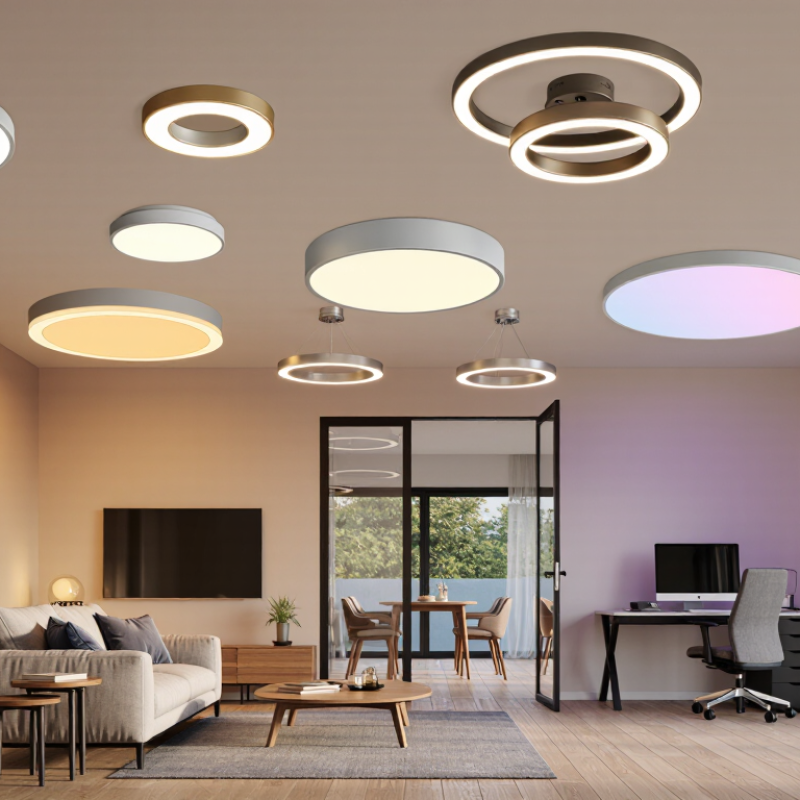
For global buyers, smart ceiling lights should match room function, not lumen numbers alone. In bedrooms, tunable white light supports softer evening routines and clearer morning visibility. Choose low-glare diffusers and gradual dimming. Comfort matters. In home offices, neutral white settings can improve visual focus, while flicker control reduces eye strain during long work sessions. A ceiling light with occupancy sensing may save energy, but the sensor must avoid false triggers near doors or fans.
Kitchens need stronger, evenly distributed light over counters and sinks. Flat panel fixtures suit low ceilings, while adjustable multi-light designs help reduce shadows. Bathrooms require suitable moisture protection and careful installation away from direct water exposure. Living rooms benefit from layered scenes, including warm dimming for television and brighter settings for cleaning. One common mistake is trusting app features before checking manual controls. A light that becomes difficult to operate during a network outage is not practical.
Market conditions also affect the buying decision. Verify voltage, frequency, socket design, wireless compatibility, and local safety certifications before ordering internationally. In regions with unstable internet, Bluetooth or physical wall controls may be more reliable than cloud-only systems. In humid or dusty climates, inspect the enclosure rating and heat management. Housing styles differ too. A compact fixture may suit dense urban apartments, while larger rooms may need higher output or multiple connected lights. Specifications can look impressive, yet installation support and replacement parts deserve equal attention.
Smart ceiling lights now include dimmable, tunable-white, occupancy-sensing, and daylight-responsive models. For global buyers, safety should guide selection before connectivity features. A 2023 U.S. Department of Energy report states that LED products use at least 75% less energy than incandescent lamps. They may also last up to 25 times longer. That advantage depends on thermal design, driver quality, and stable installation.
Look for testing against IEC 60598-1 for general luminaire safety. LED drivers should also meet relevant IEC 61347 requirements. Photobiological risk matters in bright, cool-white products, especially in schools and healthcare areas. IEC 62471 testing can help evaluate optical safety. A ceiling light should not expose users to sharp glare or visible flicker. Small details matter.
Energy labels and efficiency rules differ across markets. Buyers should check local requirements for EMC, radio performance, RoHS, and electrical safety before shipment. The European Commission’s lighting rules emphasize efficient light sources and product information, while FCC requirements apply to certain wireless devices sold in the United States. Compliance is not universal. One certificate rarely covers every destination. A practical mistake is trusting a supplier’s “global approval” claim without reviewing test scope, voltage range, emergency behavior, and installation instructions. Connectivity can fail. Safe lighting must not.
Call us one of our 3 offices across Ontario, Canada
Thanks for contacting us!
We'll get back to you as soon as possible.